Worked with · 08 of 12Onchain datanansen.ai
Nansen
I collaborated with the Nansen team on research around onchain data, wallet behavior and the problem of turning raw blockchain activity into useful market intelligence.
Attribution
A large part of the work was about attribution. A transaction on its own tells you very little. The useful part starts when you can understand whether the address belongs to an exchange, fund, market maker, protocol treasury or an active trader, and then place its activity in the context of the other wallets around it.
Fig. 1From a transaction to a reading
- 01TransactionOn its own, very little
- 02AddressWho sent it
- 03EntityExchange, fund, market maker, treasury or trader
- 04ContextThe wallets around it
Labels
I spent time looking at how wallet labels and behavioral classifications could be used without treating them as ground truth. Nansen combines entity attribution with behavioral labels and performance-based categories such as Smart Money. I was interested in where those labels create a useful signal, where they introduce noise, and what additional context is needed before drawing a conclusion from a wallet movement.
Smart Money
Smart Money analysis was part of that work. Rather than treating a large transfer as a signal by itself, I looked at historical PnL, win rate, previous entries and exits, counterparties, token flows and the wider behavior of the wallet. The same inflow can mean very different things when it comes from a consistently profitable trader, a market maker rebalancing inventory or an exchange-controlled address.
Fig. 2The same inflow, three readings
A consistently profitable trader
A market maker rebalancing inventory
An exchange-controlled address
Relationships
Another part of the work involved wallet and entity relationships. Individual addresses are often only fragments of a larger picture, so I looked at transaction histories, counterparties and behavioral patterns to understand when several addresses should be analyzed together and when an apparent connection was too weak to rely on.
Fig. 3Fragments of one picture
Schematic
Across chains
I also worked with cross-chain activity. Capital increasingly moves between Ethereum, L2s and other ecosystems, which makes a single-chain view incomplete. I looked at how the same participant or strategy changes across networks and how bridge activity, exchange flows and protocol interactions can help reconstruct that movement.
Fig. 4What reconstructs a movement across chains
- Bridge activity
- Exchange flows
- Protocol interactions
Token level
Token-level research brought those pieces together. I used wallet behavior, holder distribution, inflows and outflows, Smart Money activity and protocol interactions to distinguish changes in positioning from simple changes in token balances.
What I took from it
The most useful part of the collaboration was learning where onchain data stops being descriptive and starts becoming decision-useful. More data did not automatically produce a better signal. The work was usually about finding the small number of wallets, flows or behavioral changes that actually explained what was happening in a market.
That changed how I approach blockchain research more broadly. I became much more careful about attribution, clustering and context before treating an onchain movement as evidence of investor intent.
Materials
Public pages about the company and the programs around this work.
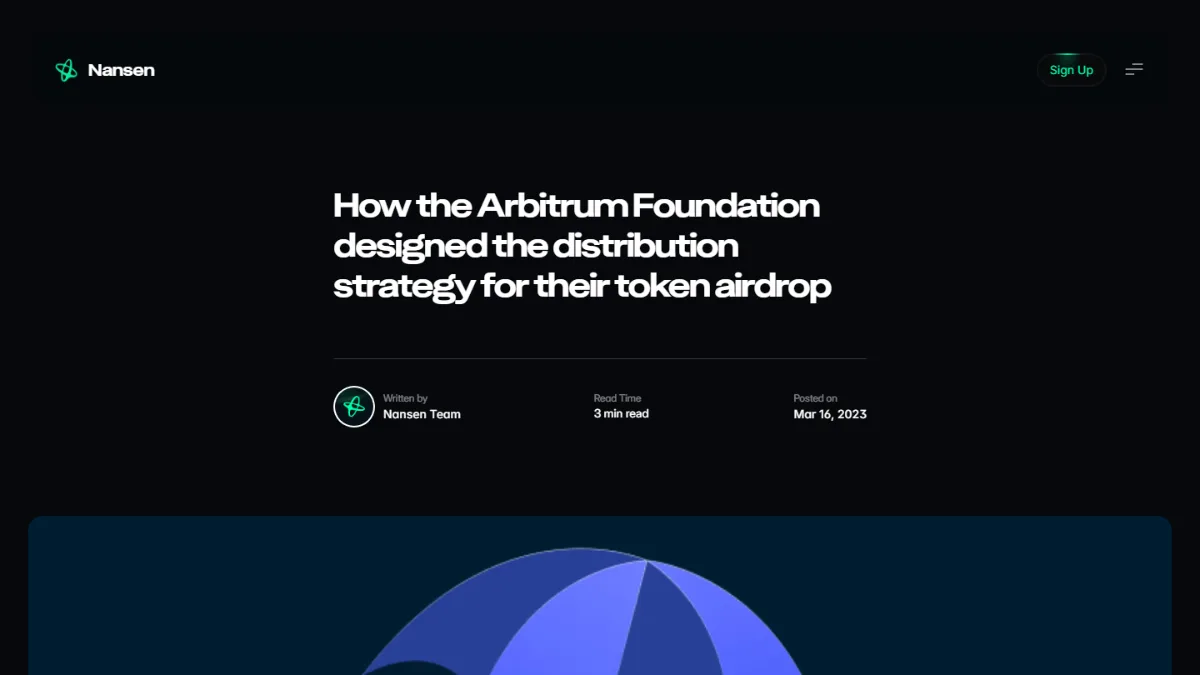 Screenshot, Oct 5, 2026
Nansen · March 2023
How the Arbitrum Foundation designed its airdrop distribution
Nansen on its work with the Arbitrum Foundation on the distribution strategy for the ARB airdrop.
Screenshot, Oct 5, 2026
Nansen · March 2023
How the Arbitrum Foundation designed its airdrop distribution
Nansen on its work with the Arbitrum Foundation on the distribution strategy for the ARB airdrop.
Further reading