Worked with · 06 of 12Token launchespump.fun
pump.fun
I worked with the pump.fun team on research around token launch mechanics, liquidity formation and incentive design.
The cold start
What interested me most was the transition from a token with no existing market to one with real liquidity and price discovery. Pump.fun handles that cold start through a bonding curve. A coin can trade immediately after creation, with liquidity and pricing coming from the curve rather than from a separately seeded order book or liquidity pool.
Fig. 1A market from the first trade
Shape of a constant-product curve, not pump.fun’s parameters
Along the curve
I spent time looking at how behavior changes along that curve. Early liquidity is structurally different from liquidity in a mature market. Trade size, position in the curve, concentration of early holders and the speed at which new buyers arrive can all change what the same headline market cap actually represents.
Graduation
Graduation was another important point in the lifecycle. Once the bonding curve completes, the token moves automatically into its canonical PumpSwap pool. That changes the market structure. The asset moves from a launch mechanism with predetermined curve mechanics into an AMM where liquidity, trading activity and the composition of fees become more important.
Fig. 2The lifecycle
- 01CreatedA new coin
- 02Bonding curveTrading from the start
- 03GraduationThe curve completes
- 04PumpSwapIts canonical pool
- 05AMM marketLiquidity, activity and fees
After the launch
I looked at that transition as more than a technical migration. It is the point where you can start asking whether a token has developed a market that can survive outside the initial launch mechanism. Volume alone is not enough. I was interested in how concentrated the activity was, whether liquidity remained usable as trade size increased, how holder behavior changed, and what happened after the initial attention around a launch faded.
Fig. 3Questions after graduation
- 01How concentrated the activity was
- 02Whether liquidity stayed usable as size grew
- 03How holder behavior changed
- 04What happened after attention faded
Creator incentives
Creator incentives were another part of the work. Pump.fun routes part of trading fees back to token creators, which changes the relationship between launching a token and maintaining an active market around it. I looked at how different fee structures change incentives for creators, traders and liquidity providers, and where those incentives can reinforce healthy activity or reward short-lived volume instead.
That became more interesting as the platform added ways to split creator fees between multiple recipients and, later, route fees directly to holders. At that point the fee system becomes part of the token’s economic design. The same trading activity can compensate a creator, a group of contributors or the holders themselves depending on how the coin is configured.
Fig. 4Where the creator fee goes
- CreatorOne recipient
- ContributorsSplit between several
- HoldersRouted directly to them
Market and mechanics
The broader question for me was how much of a token’s early success comes from the market itself and how much comes from the mechanics around its launch. A bonding curve can solve the initial liquidity problem, and incentives can give creators a reason to keep building, but neither automatically creates a durable market.
What I took from it
I came away looking at pump.fun less as a token generator and more as a market-design system. It compresses token creation, initial price discovery, liquidity formation, graduation and creator economics into one lifecycle. That makes it a useful place to study how very small changes in incentives can affect who launches, who trades, how liquidity develops and what survives once the first wave of attention is gone.
Materials
Public pages about the company and the programs around this work.
 Screenshot, Oct 5, 2026
pump.fun docs
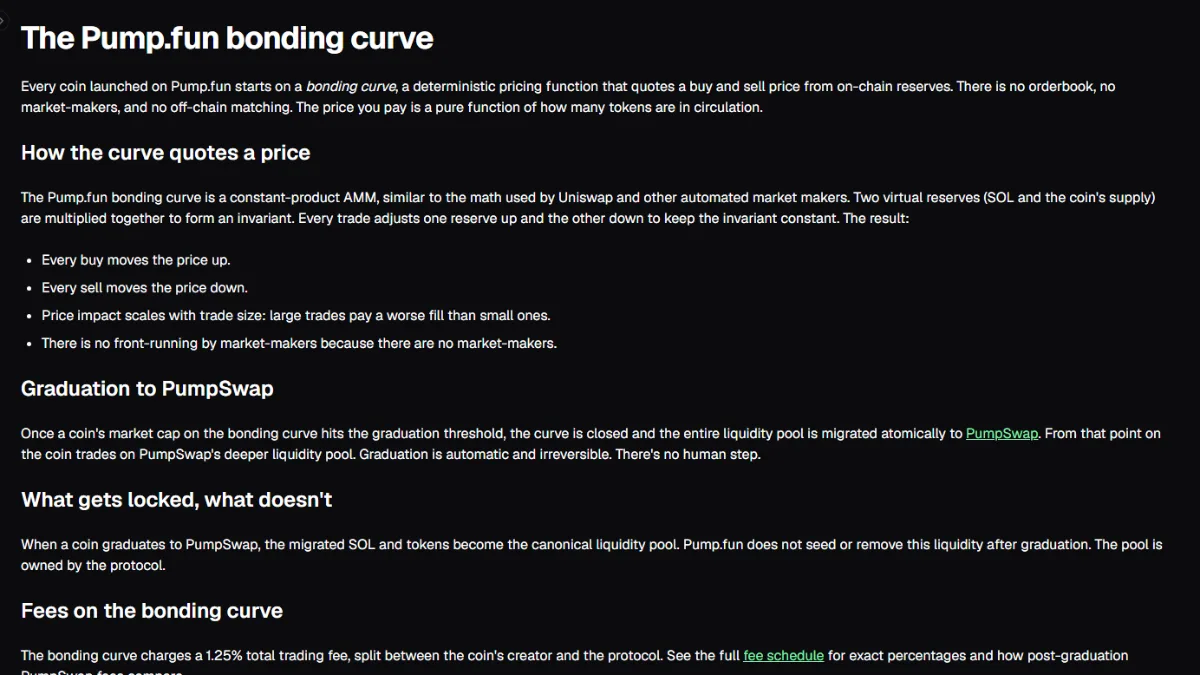
The pump.fun bonding curve
How the curve quotes a price from onchain reserves, and how a coin graduates to PumpSwap.
Screenshot, Oct 5, 2026
pump.fun docs
The pump.fun bonding curve
How the curve quotes a price from onchain reserves, and how a coin graduates to PumpSwap.
Further reading