Worked with · 01 of 12Stablecoinsethena.fi
Ethena
I collaborated with the Ethena team on paid research around USDe, focusing on the market structure and risk assumptions behind the synthetic dollar.
How the pieces fit
A large part of my work was understanding how the different pieces of the system behave together. USDe is backed by protocol-held assets alongside offsetting derivatives positions, so I looked at collateral composition, hedge construction, funding and basis conditions, and the infrastructure used to keep the protocol close to delta neutral as market conditions change.
Fig. 1Mint and redeem
Mint
- Collateral inCrypto collateral is deposited
- Held off exchangeCustodians hold it, exchanges credit it as margin
- Short perpetualThe same size, so price moves cancel out
- USDe outA dollar backed by the hedged position
Redeem
- USDe burned
- Short closed
- Released from custody
- Collateral returned
Mint and redemption
I also spent time on the mint and redemption side. Direct minting and redemption depend on a relatively small set of permissioned market participants and on the protocol being able to move between stable collateral, spot assets and hedging positions efficiently. That made liquidity an important part of the work. I looked at what happens when redemption demand increases, market depth becomes thinner, or the cost of rebalancing changes quickly.
Custody and counterparties
Custody and counterparty structure were another part of the analysis. Ethena uses off-exchange settlement providers so backing assets can remain in custody while being delegated to trading venues for hedging. I looked at the dependencies this creates around exchanges, custodians, settlement availability and the protocol’s ability to move hedges when one part of that infrastructure is under stress.
Fig. 2Where the backing sits
- Backing assetsHeld with off-exchange settlement providers
- Trading venuesCredit the delegated assetsCarry the hedges
- Under stressAn exchangeA custodianSettlement availability
Funding
Funding was especially interesting because it affects both protocol economics and risk. Positive funding can contribute to protocol revenue, while extended periods of negative funding create a very different operating environment. We worked through scenarios where funding deteriorates at the same time as liquidity, collateral conditions or redemption pressure, rather than treating each risk independently.
Fig. 3Perpetual funding, a year of daily data
Each day30-day average
BTCMedian +4.0% · negative on 21% of days · low −10.5%
ETHMedian +3.5% · negative on 25% of days · low −16.4%
Monthly averages as a table
| Month | BTC | ETH |
|---|---|---|
| October 2025 | +2.8% | +3.5% |
| November 2025 | +5.4% | +5.2% |
| December 2025 | +5.0% | +4.2% |
| January 2026 | +5.4% | +4.8% |
| February 2026 | −0.8% | −4.0% |
| March 2026 | −1.1% | −1.1% |
| April 2026 | −2.2% | −1.6% |
| May 2026 | +2.7% | +3.4% |
| June 2026 | +2.5% | +0.6% |
| July 2026 | +6.7% | +4.1% |
| August 2026 | +7.3% | +5.7% |
| September 2026 | +5.5% | +4.9% |
| October 2026 | +4.5% | +4.4% |
Data: Binance USD-M perpetuals, Oct 5, 2025 to Oct 4, 2026
Fig. 4Stress scenarios
- 01Prolonged negative funding
- 02Large redemption waves
- 03Thinner exchange liquidity
- 04Collateral dislocations
- 05Several at once
Shapes, not data
The Reserve Fund
The Reserve Fund was part of that work as well. I looked at its role as additional protection during periods of negative funding and market stress, and at the broader question of how much buffer a synthetic dollar needs when its revenue and hedging costs are both market-dependent.
Fig. 5Funding cuts both ways
Schematic, not market data
Outside the protocol
I also worked on the second-order effects of USDe and sUSDe becoming deeply integrated across DeFi. Once an asset is used as collateral in lending markets, routed through liquidity pools, split into fixed and variable yield products, or used inside leveraged strategies, its risk no longer stops at the boundary of the issuing protocol. I was interested in where those integrations create useful liquidity and where they can create correlated exits or leverage that becomes visible only during stress.
Fig. 6Outside the protocol
- CollateralBorrowed against in lending markets
- LiquidityPaired in trading pools
- YieldSplit into fixed and floating yield
Borrow against it, buy more, deposit again. Each turn of the loop adds leverage on top.
What I took from it
The collaboration gave me a much more detailed view of synthetic dollar design. I came away thinking about USDe less as a single peg mechanism and more as a system of collateral, derivatives, custody, liquidity and external integrations that all need to keep working under very different market conditions.
Fig. 7One system, five parts
- Collateral
- Derivatives
- Custody
- Liquidity
- External integrations
Materials
Public pages about the company and the programs around this work.
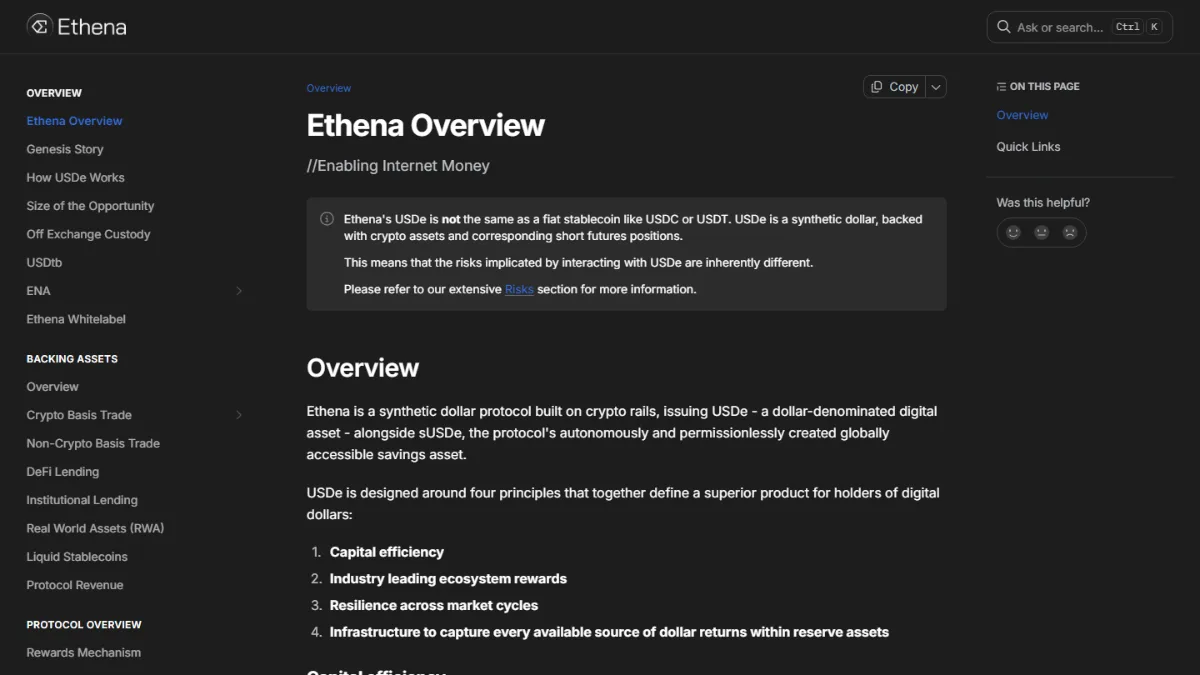 Screenshot, Oct 5, 2026
Ethena documentation
USDe overview
Ethena’s own account of USDe: a synthetic dollar backed by crypto assets and the short futures positions that hedge them.
Screenshot, Oct 5, 2026
Ethena documentation
USDe overview
Ethena’s own account of USDe: a synthetic dollar backed by crypto assets and the short futures positions that hedge them.
Further reading