Worked with · 12 of 12Medical roboticsendiatx.com
Endiatx
I collaborated with the Endiatx team on research around swallowable robotics, remote navigation and the systems needed to operate a robot reliably inside the human body.
Where an image came from
A large part of my work was about the difference between capturing an image and understanding where that image came from. With a swallowable robot, the camera is constantly moving through an environment that is deformable, visually repetitive and difficult to localize inside.
Fig. 1An environment that resists a map
- Deformable
- Visually repetitive
- Difficult to localize inside
Context for the physician
I spent time looking at how real-time video, motion and spatial context could be combined so that a physician has a better understanding of where the robot is and what has already been inspected.
Fig. 2Three signals, one picture
- Real-time videoWhat the camera sees
- MotionHow the robot moved
- Spatial contextWhere it is, what was inspected
Navigation
Navigation was another important part of the work. PillBot uses miniature pump-jet motors to move inside the stomach under physician control. That creates a very different control problem from a conventional endoscope. There is no rigid mechanical connection between the physician and the device, so movement has to be understood through video and the robot’s own response to the surrounding environment.
Fig. 3Two control problems
A conventional endoscope
- A rigid mechanical connection to the physician
PillBot
- Miniature pump-jet motors
- No rigid connection
- Movement read through video and the robot’s response
When the loop slips
I was interested in what happens when that control loop becomes less predictable. Visibility can change, orientation can be lost, movement can produce a different result than expected and the robot still needs to give the operator enough information to recover.
Fig. 4When control gets less predictable
- 01Visibility changes
- 02Orientation is lost
- 03A movement lands somewhere unexpected
- 04The operator still needs enough to recover
Procedure data
Another part of the work involved the data produced during each procedure. A swallowable robot can generate more than a sequence of images. If visual observations can be associated with movement and spatial context, repeated procedures can produce a much richer representation of the stomach.
Beyond visualization
That becomes increasingly important as the platform moves beyond visualization. Endiatx is developing the same underlying robotic platform toward active navigation, targeted intervention and eventually coordinated robotic systems. The requirements become stricter as the robot moves from observing tissue to interacting with it.
Fig. 5One platform, stricter at each step
- 01VisualizationObserving tissue
- 02Active navigation
- 03Targeted intervention
- 04Coordinated systemsInteracting with it
Supervision
I also looked at the role of human supervision. In this type of system, autonomy does not need to mean removing the physician. A more useful question is which parts of navigation, orientation and scene understanding can be assisted by software while keeping clinical judgment and control with the person operating the system.
Fig. 6Who does what
Software can assist
- Navigation
- Orientation
- Scene understanding
Stays with the physician
- Clinical judgment
- Control
What I took from it
The work made me think about robotics differently. Inside the body, sensing, navigation, control and safety cannot be separated cleanly. Every improvement in autonomy has to work within the physical limits of the capsule and the fact that the system is operating in a live human environment.
Materials
Public pages about the company and the programs around this work.
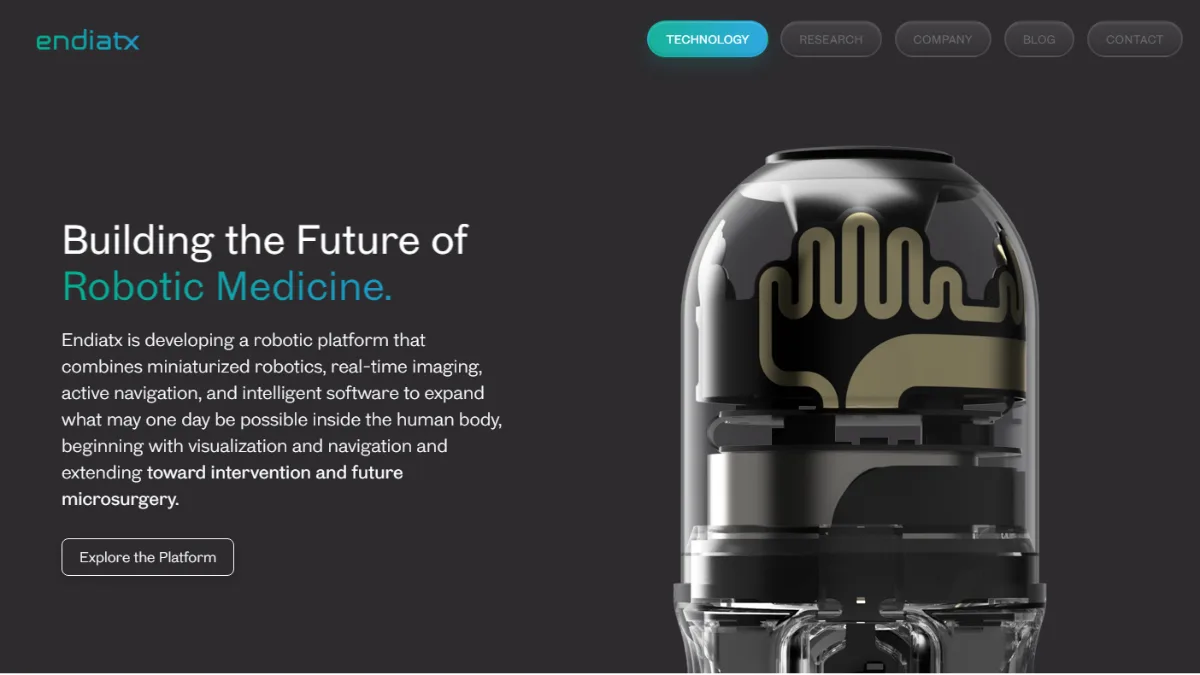 Screenshot, Oct 5, 2026
Endiatx
Endiatx technology
The robotic platform, from visualization and navigation toward intervention.
Screenshot, Oct 5, 2026
Endiatx
Endiatx technology
The robotic platform, from visualization and navigation toward intervention.
Further reading