an hour of ethereum's blob space cost $1.94. who bought it
who bought ethereum's blob space in one hour on 15 september 2026, rollup by rollup, and what they paid: 1,576 blobs for $1.94 in total.
· berlin · alina schanz
- question
- the buyers of one hour of ethereum's blob space, and the price they paid.
- data
- 297 blocks, 25,982,236 to 25,982,532, on tuesday 15 september 2026 from 10:21 to 11:21 utc, read from one public node.
- method
- blobwatch prices every blob11 blobwatch as of 15 sep 2026: my newest commit before it was 1587549 (10 sep 2026), signed with my key. the code. from its block header and groups the blobs by the inbox they went to. the command is under method.
- finding
- the hour cost every rollup on ethereum together 0.00078 eth, $1.94. robinhood chain posted more blobs than base.
data
blobwatch --since 1h --json.| blocks# | 297 (25,982,236 to 25,982,532) |
|---|---|
| blobs# | 1,576 · 5.3 per block |
| the schedule# | bpo2: target 14, max 21 per block |
| blocks with no blob · full blocks# | 40 · 0 |
| blob base fee# | 0.0030 to 0.0057 gwei, median 0.0037 |
| paid for all blobs# | 0.00078 eth · $1.94 |
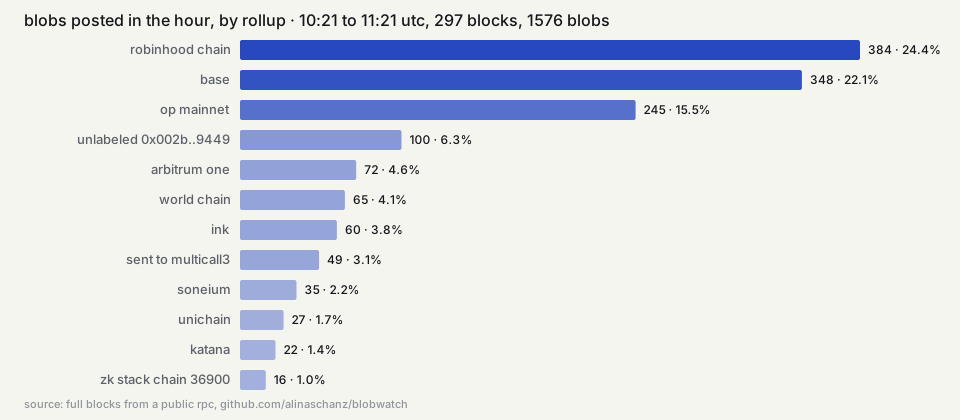
| poster | blobs | share | txs | per tx | paid |
|---|---|---|---|---|---|
| robinhood chain# | 384 | 24.4% | 128 | 3.0 | $0.47 |
| base# | 348 | 22.1% | 58 | 6.0 | $0.42 |
| op mainnet# | 245 | 15.5% | 49 | 5.0 | $0.30 |
| unlabeled 0x002b..9449# | 100 | 6.3% | 25 | 4.0 | $0.12 |
| arbitrum one# | 72 | 4.6% | 24 | 3.0 | $0.09 |
| world chain# | 65 | 4.1% | 13 | 5.0 | $0.08 |
| ink# | 60 | 3.8% | 10 | 6.0 | $0.07 |
| sent to multicall3# | 49 | 3.1% | 49 | 1.0 | $0.06 |
| soneium# | 35 | 2.2% | 7 | 5.0 | $0.04 |
| unichain# | 27 | 1.7% | 9 | 3.0 | $0.03 |
| katana# | 22 | 1.4% | 9 | 2.4 | $0.03 |
| zk stack chain 36900# | 16 | 1.0% | 8 | 2.0 | $0.02 |
| metal l2# | 15 | 1.0% | 15 | 1.0 | $0.02 |
| lighter# | 14 | 0.9% | 14 | 1.0 | $0.02 |
| hemi# | 12 | 0.8% | 12 | 1.0 | $0.01 |
| starknet# | 12 | 0.8% | 2 | 6.0 | $0.01 |
observations
that is 5.3 blobs a block against a target of 1444 from the limits: "one hour of one tuesday morning.". the blob fee has one rule: above target the price rises, below it the price falls, down to a floor. it sat at the floor all hour, and the weekly note has it at the floor all week, median 0.0036 gwei over 50,400 blocks. demand could grow two and a half times before the price moved.
robinhood chain posts more blobs than base. it is an arbitrum orbit chain with chain id 4663; blobwatch found the name by asking its inbox contract for its bridge, the bridge for its rollup and the rollup for its chain id, because nobody had written the inbox down. it sends 3 blobs per transaction, 128 transactions in the hour, one every 2.3 blocks. base sends 6 per transaction and needs 58. op mainnet, 245 blobs, is third.
the inbox 0x002b…9449 posted 100 blobs and is still the biggest poster without a name; the issue is open, and if you know whose it is, that is the place. the 49 blobs sent to multicall3 came in 49 transactions from unrelated senders sharing one contract, one blob each; that looks like individuals, and i do not know yet what they post. starknet is the other end of the table, 2 transactions in the hour with 6 blobs each, the largest batches and the fewest.
1,576 blobs at a median blob base fee of 0.0037 gwei. robinhood chain paid $0.47 for its 384 blobs, base $0.42. the blob space itself cost the rollups on ethereum under two dollars for the hour55 from the limits: "the total counts blob gas only.", all of them together.
method
blobwatch --since 1h --jsonpython 3.10+, standard library, one public node. a full block is about half a megabyte, so an hour is around 150 megabytes of download and took two and a half minutes on my connection. a blob is 131,072 units of blob gas, and blobwatch computes the blob base fee from each header's excess blob gas with the integer arithmetic of eip-4844, the way clients do. the target and the maximum per block come from eth_config.
the names come from a table with a source on every row, or from the chain itself; "origin" in the json says which.
sources
- blocks and headers: a public json-rpc node. blobwatch tries publicnode, mevblocker, drpc, tenderly and blastapi in that order.
- the fee arithmetic: eip-4844. the schedule:
eth_config, from eip-7910. - names: the op superchain registry, verified contracts on blockscout, blobscan's attribution, and chain ids from chainid.network.
- robinhood chain: its own contracts, from the inbox to chain id 4663.
- the dollar figure: coingecko's eth price at the time of the run, $2,481.
limits
- one hour of one tuesday morning. the ranking moves: in ten minutes on 21 september, base posted 118 blobs and robinhood chain 102.
- the total counts blob gas only. the same transactions pay execution gas for their calldata;
--receiptsadds that column, and when the base fee is up it is the larger number. - the floor moves with the execution base fee. eip-7918 keeps the blob fee near a sixteenth of it, so the same hour costs more on a day of higher gas.
- 100 blobs went to an inbox nobody has named, and i cannot name an owner for the 49 blobs sent to multicall3.
- one run against one public node. another node, or a block later, moves the edges of the window.
revised 21 sep 2026. the note now lays out question, data, method, observations, sources and limits. the figures from 15 september did not change; the two lines that cite 21 september say so. none of it is advice. if a name in the table is wrong, the source field in the json says where it came from, and i want to hear about it.
revised 23 sep 2026. the links to my code now point to the copies on this site, and short notes in the margin say where a figure came from. the figures and the sentences above did not change.